

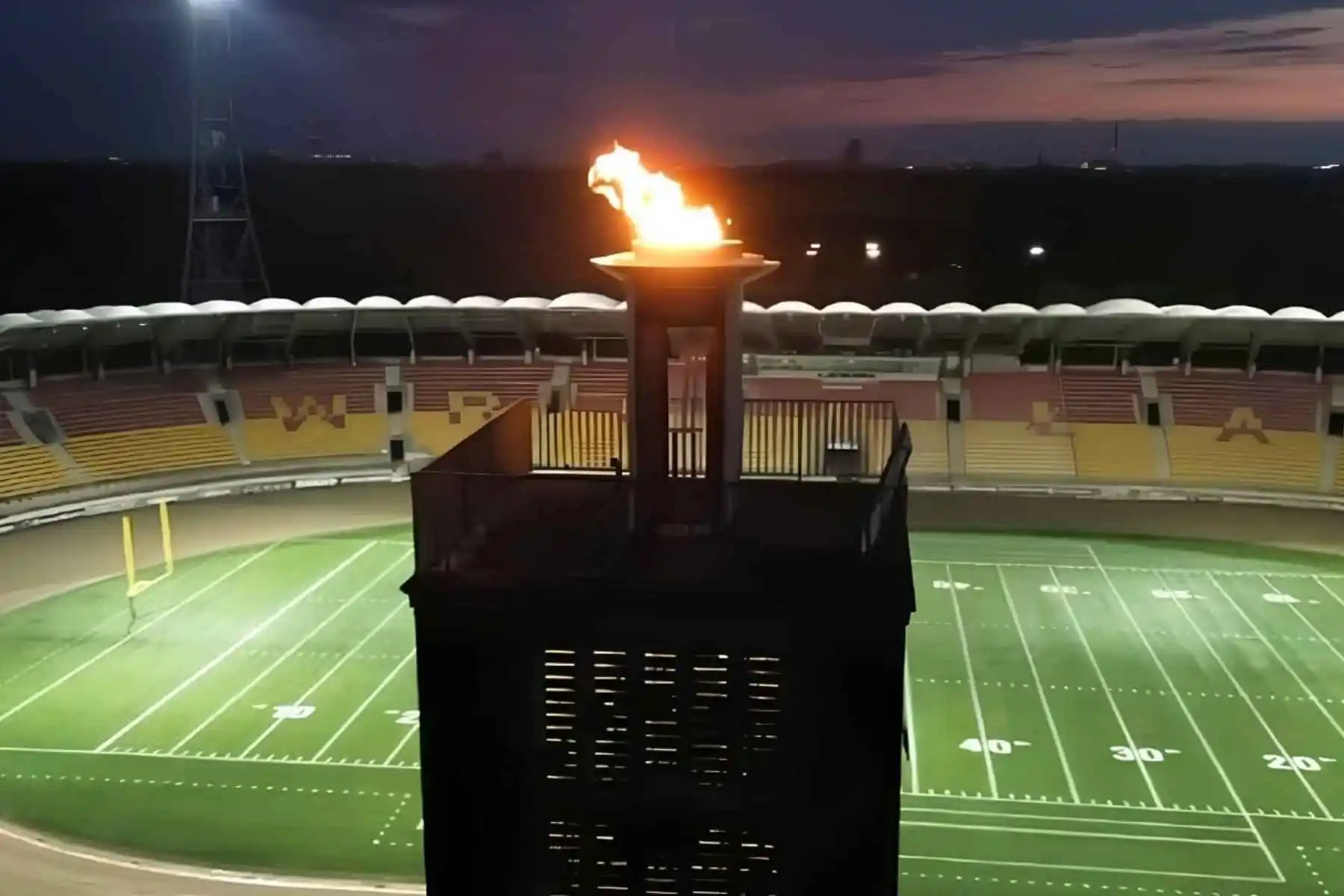
The Wrocław Olympic Stadium flame lit up again on the evening of August 6, after almost 90 years without it. In fact, it has the same shape and the same size as in 1936. Inside, though, the technology is completely different.
Wrocław Olympic Stadium flame – a piece of history returns
The clock tower at the Olympic Stadium has stood since 1936. Back then, the building was part of a pre-war sports complex, in a city that carried a different name, under a different country. From the very beginning, a flame sat on top of the tower, a witness to pre-war sporting events. Then it went dark for nine decades.
The tower has just gone through months of restoration work. Conservators repaired the facade, dried out damp masonry, and replaced the roof. In doing so, they brought the historic structure up to today’s technical standards while keeping its original character. The final piece of that work restored the flame to its original purpose.
As Łukasz Wójcik, director of the Youth Sports Center in Wrocław, put it, the flame today is “the same as it was 90 years ago” in shape and size. However, the difference lies in the technology powering it.
What’s behind the flame
We built the new torch element from stainless steel, matching the historic form precisely. On top of that, we handled everything connected to the flame itself: the gas installation and the control system, start to finish. That means the first drawing, and it means the first ignition on the tower.
Why this project is different
A roofing torch has clearly defined parameters. You know what kind of flame it needs to produce, how much gas it should use, and how long it needs to run without interruption. A flame on a historic tower is a completely different challenge. We had to design a system that recreates a 90-year-old look. At the same time, it needed to meet today’s safety standards and allow remote control from ground level. After all, nobody wants to climb to the top of the tower every time someone needs to light or extinguish the flame.
For a project like this, there’s no catalog to check. Instead, you sit down, design the solution from scratch, and test it until it works flawlessly the first time. After all, there’s no second chance at relighting a flame after 90 years.
Not our first flame
This isn’t the first time we’ve done something like this. In 2023, for example, we designed and built the gas system for the cauldron flame at the opening ceremony of the European Games Kraków–Małopolska. That flame had to be dramatic, stable, and wind-resistant. Thousands of spectators had their eyes on the stadium at exactly that moment. You can read more about that project in our article about the European Games 2023 cauldron flame in Kraków.
The Wrocław Olympic Stadium flame is a different kind of challenge, though. It’s not a one-off ceremony. Instead, we built it to run reliably for years to come. The working method, however, stays the same: design from zero, test, and get it right down to the last detail.
What’s next for the Wrocław Olympic Stadium flame
Over the next 12 months, the Youth Sports Center has contracted 10 more lightings of the flame. So far, the exact dates aren’t set yet. Still, one thing is certain: the Wrocław Olympic Stadium flame is now visible from across the whole venue, a small piece of Słone burning over Wrocław.
In short, custom projects like this one are exactly the kind of work we enjoy most: something with no catalog page, something you have to design from scratch and get exactly right.
Source: Radio Wrocław
Frequently asked questions
Is this the first flame installation KOMA has worked on?
No. In 2023, we designed and built the gas system for the Olympic-style cauldron flame at the European Games in Kraków.
Who’s responsible for the gas system behind the Wrocław Olympic Stadium flame?
Everything related to the gas installation and flame control is our work – from design to commissioning.
How many more times will the flame be lit this year?
According to the Youth Sports Center, 10 more lightings are planned over the next 12 months.


